I still remember the first time I glued a rocket to a wooden board in The Legend of Zelda: Tears of the Kingdom and launched Link across the Gerudo Desert. My contraption wobbled, spun wildly, and dumped me unceremoniously into a Molduga’s mouth, but I was hooked. That moment of chaotic flight crystallized what millions of players already knew: this game isn’t just an open-world masterpiece—it’s a sandbox for everyday engineers. Fast-forward to 2026, and that playful tinkering has taken a serious turn. The University of Maryland, College Park, now offers a pilot course that uses Tears of the Kingdom to teach machine design fundamentals to second-year mechanical engineering students. Yes, you read that correctly—playing Zelda can now earn you college credit.
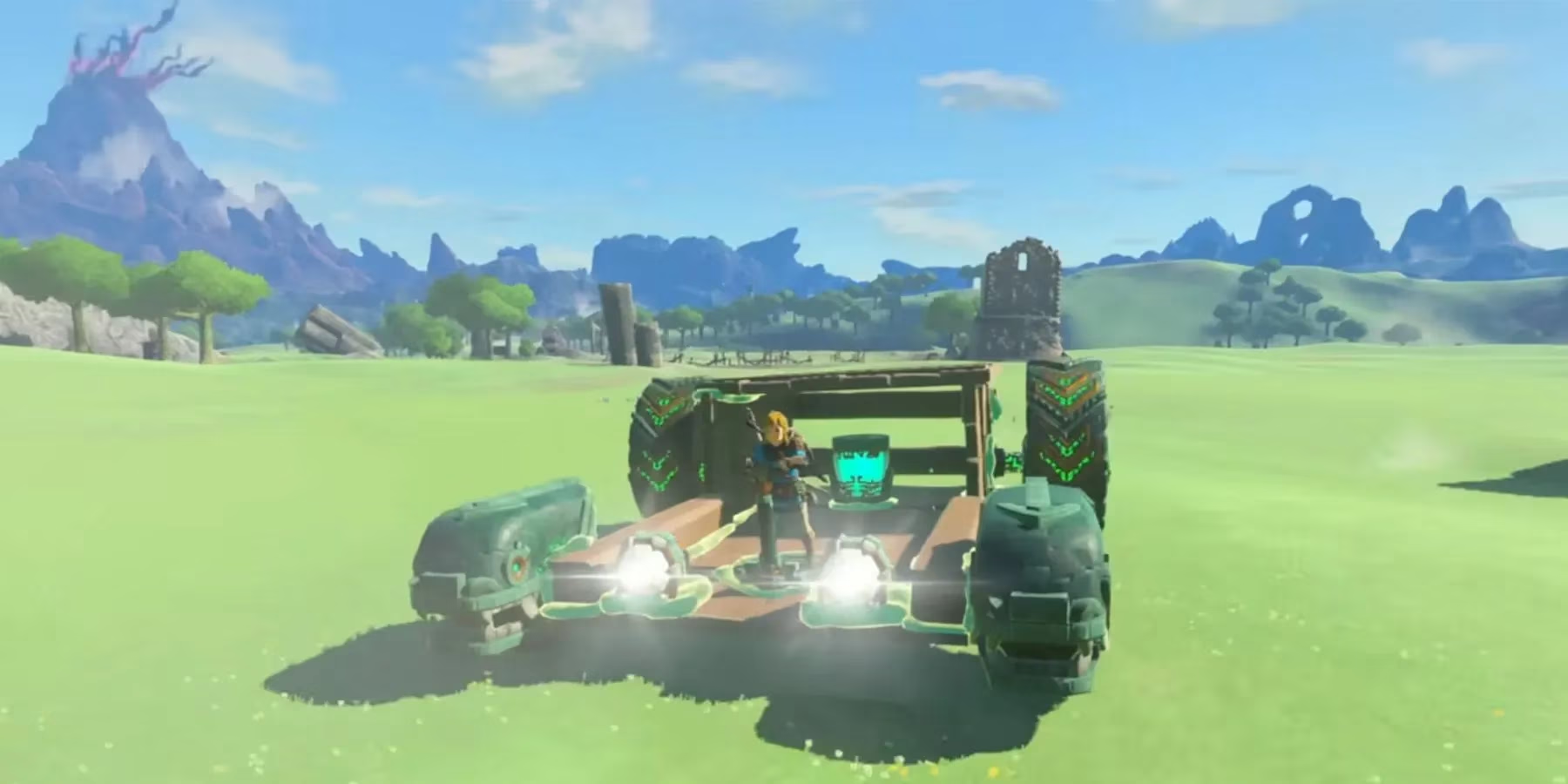
I’ve spent over 300 hours in Hyrule’s latest iteration, and even I find it astonishing that the same Ultrahand ability I used to attach Koroks to rockets is being dissected in a lecture hall. Professor Ryan D. Sochol, a lifelong Zelda fan, designed the course—officially titled “The Legend of Zelda: A Link to Machine Design”—to merge entertainment with rigorous engineering concepts. Each student receives a Nintendo Switch, a Pro Controller, and a copy of the game for the semester. The syllabus? A three-part journey that mirrors the in-game shrines themselves.
🛠️ How the Course Works
The class unfolds in three stages, each tapping into a different layer of Tears of the Kingdom’s mechanics. First, students complete specific shrines that introduce fundamental machine elements—springs, wheels, stabilizers, and fans. Think of it as a whimsical physics lab where failure is as instructive as success. I’ve lost count of the times my flying machine nosedived because I misaligned a fan, and I can only imagine the technical discussions those crashes spark when backed by a professor’s analysis.
Next comes the deep dive. Each student picks one machine element and studies it exhaustively, producing technical data like horsepower output and thrust calculations. The humble Zonai fan, for instance, isn’t just a magical leaf-blower; it has a measurable RPM range and a thrust-to-weight ratio that varies with battery consumption. In my own messy builds, I never bothered with numbers—I just stacked more rockets and hoped for the best. But that second step transforms gameplay into a legitimate engineering exercise.
Finally, there’s the capstone design challenge. Professor Sochol shared a video (first spotted by GoNintendo) showing a race where students must construct a vehicle capable of traversing both land and water. Watching those hybrid machines wobble into the surf reminded me of my amphibious attempts near Lurelin Village, except these contraptions are graded on efficiency, not just survival. It’s the kind of hands-on problem-solving that bridges the gap between virtual inventing and real-world machine design.
🔧 My Own Ultrahand Epiphanies
I can’t help but compare the course structure to my own learning curve in Hyrule. When Tears of the Kingdom launched in 2023, the building mechanics felt limitless. The community immediately erupted with creations: a life-sized AT-AT from Star Wars, the USS Enterprise sailing above Death Mountain, and even a fully articulated flying mech. I personally spent an entire weekend trying to build a self-stabilizing bridge to cross Tanagar Canyon—it collapsed eleven times before I discovered the magic of interlocking stabilizers and stakes. That trial-and-error process mirrors the iterative design philosophy taught in engineering programs.
In hindsight, the shrines were stealth tutorials for concepts like torque, balance, and momentum transfer. The Jirutagumac Shrine, for example, forced me to align rotating gears to lift a platform. At the time, I just saw a puzzle; now I recognize it as a lesson in mechanical advantage. The course at UMD formalizes that hidden curriculum, making explicit what we players absorbed by instinct.
🎮 Beyond the Classroom: A New Educational Frontier
What’s remarkable is that this isn’t a gimmick. Tears of the Kingdom has long been hailed as a master class in open-world design, expanding on Breath of the Wild’s revolutionary formula with deeper physics and a more emotionally resonant story. Yet its building mechanics have become a unique educational tool. The game’s physics engine—wind resistance, weight distribution, buoyancy—is accurate enough to illustrate real principles without the intimidation of a CAD lab. Professor Sochol’s pilot course may soon inspire similar programs in other universities, and I wouldn’t be surprised if Tears of the Kingdom ends up in engineering syllabi worldwide.
As a player, it’s thrilling to see my favorite hobby elevated to academic legitimacy. I’ve never experienced anything quite like the moment I first flew a custom-built airship from Skyview Tower to the floating ruins of Zonai architecture—a blend of awe, accomplishment, and the nagging sense that I’d just applied aerodynamics without realizing it. That feeling has now been packaged into a credit-bearing course, and honestly, I’m a little jealous.
📝 Course at a Glance
| Week | Focus Area | Gameplay Task | Engineering Concept |
|---|---|---|---|
| 1-4 | Machine basics | Complete elemental shrines | Identify simple machines (lever, wedge, wheel) |
| 5-8 | In-depth analysis | Isolate one element (e.g., spring) | Calculate spring constant, energy storage |
| 9-14 | Design challenge | Amphibious vehicle race | Integrate systems for dual-terrain travel |
Based on Professor Sochol’s description, with my own flavor of imagining the technical details.
🌟 Why This Matters in 2026
Three years after its release, Tears of the Kingdom continues to evolve in our collective consciousness. It’s no longer just a contender for Game of the Year (which it rightfully earned in 2023); it’s a gateway drug for young engineers. The University of Maryland’s initiative underscores how video games can transcend entertainment and become interactive textbooks. When I revisit Hyrule now, I see every Korok puzzle not as a chore but as a mini engineering problem waiting to be optimized. Maybe I’ll finally earn that mechanical engineering degree I never knew I was studying for.