In 2025, The Legend of Zelda: Tears of the Kingdom continues to stand as a monumental achievement in interactive entertainment, not merely for its scale but for its masterful genre fusion. While its open-world structure provides the canvas, the game’s true innovation lies in its gameplay synthesis, birthing a hybrid experience some have termed the Survival Platformer. This emergent genre marries the precarious, momentum-based navigation of classic platformers with the resource-conscious, environmental mastery of survival games, all set across the game’s tri-layered world of Sky, Surface, and Depths. The most exhilarating and defining expression of this fusion is found high above Hyrule, where every leap is a gamble and every resource is a lifeline.
Ascending from a Skyview Tower into the archipelagos of floating islands is an immediate paradigm shift. The familiar, sprawling fields of Hyrule give way to isolated landmasses suspended in a vast, blue void. Here, navigation transforms from a question of where to go into a puzzle of how to get there. One wrong move doesn't mean a minor setback; it can mean a heart-stopping plunge back to the Surface, losing hard-earned altitude and progress. This constant, looming threat of catastrophic failure is the survivalist heartbeat of the experience. It forces players to assess each gap like a mountaineer evaluating a crevasse, calculating wind, distance, and their dwindling inventory of Zonai devices. The sky islands become a treacherous, three-dimensional obstacle course where the primary enemy is gravity itself.
The journey to the Wind Temple serves as a quintessential case study. Without the aid of Tulin's gust ability, the player is thrown into a pure survival platforming scenario. Early solutions often involve rudimentary tools: burning pine cones to create thermal updrafts for the paraglider, a method as primal as it is effective. But as resources thin and challenges grow, creativity must expand. This is where Tears of the Kingdom's genius as a Survival Platformer truly shines. Players learn to improvise with physics. Attaching a Octo Balloon to a shield becomes a makeshift hot-air lift. A Bomb Flower fused to that same shield, when ridden in a shield surf, becomes a propulsion charge, launching Link across chasms like a cannonball—a maneuver as risky as it is rewarding.
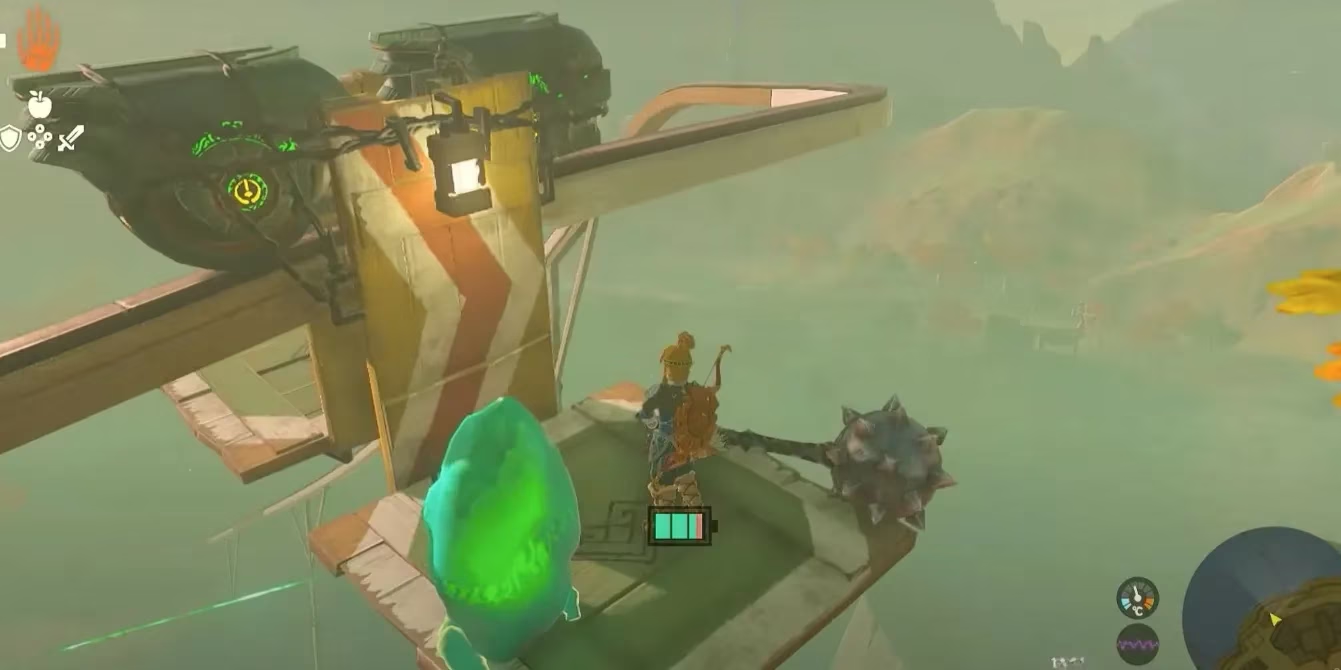
For longer traversals, vehicle construction becomes essential. The limited space on a small island ledge, coupled with a sparse inventory of fans, balloons, and control sticks, turns each build into a tense engineering puzzle. The pressure to not waste parts—watching a precious fan tumble into the abyss is a uniquely devastating feeling—mirrors the resource management of survival games. Players become adept at minimalist design: a sled, often overlooked, becomes a prized foundation for its compact size. A single rocket can be the difference between reaching a shrine platform or free-falling into oblivion. This process of building under duress, where every component is precious and failure is a long drop away, is the core survival-platformer loop.
Link's core abilities are recontextualized as vital platforming tools in this harsh environment. Recall is no longer just a puzzle mechanic; it's a salvation for dropped parts or a way to gain a few extra meters of lift from a falling platform. Ascend becomes the ultimate precision tool, allowing Link to phase through the underside of a target island after a deliberately undershot flight path—a move as clever as it is cinematic. Managing survival metrics like health and temperature adds another layer. Climbing higher often means colder air, requiring spiced meals or cold-resistant armor. A moment of respite, like a sheltered camp with a cooking pot found on the path to the Wind Temple, feels profoundly earned. These pockets of safety amidst the aerial gauntlet are like finding an oasis in a desert, a hallmark of the survival genre translated to a platforming context.
Ultimately, Tears of the Kingdom's skyward exploration feels like conducting a symphony of systems under extreme duress. The floating realms are not just levels to be crossed but ecosystems of peril to be outsmarted. The genre blend creates unforgettable moments: the frantic construction of a flying machine as a time bomb ticks down, or the serene, calculated glide between islands as a thunderstorm gathers. It proves that the most compelling challenges often arise from the intersection of established ideas. While the Survival Platformer may not become a mainstream label, the experience it describes—tense, creative, and utterly unique to Tears of the Kingdom—remains one of the game's most defining and enduring legacies in the gaming landscape of 2025.
Core Pillars of the Survival Platformer Genre in TotK:
| Pillar | Description | Example in Gameplay |
|---|---|---|
| Precarious Navigation | Movement where failure equals significant loss of progress. | Missing a glide and falling from the sky islands back to the Surface. |
| Resource-Dependent Progression | Limited inventory of key traversal items (Zonai Devices, food). | Calculating if you have enough fans and battery charge to reach the next island. |
| Environmental Mastery | Using physics and abilities creatively to overcome obstacles. | Using Recall on a falling rock to create a temporary stepping stone. |
| Survival Metric Management | Attending to health, temperature, and stamina amidst platforming. | Cooking cold-resistant food before ascending to a snowy sky island. |
Essential Sky Island Survival Kit:
🔋 Zonai Devices: Fans, Rockets, Balloons, Control Sticks, Sleds
🔥 Consumables: Pine Cones (for updrafts), Brightbloom Seeds (for dark Depths ascents), Spicy Peppers
🛡 Key Abilities: Recall (emergency retrieval), Ascend (precision landing), Fuse (improvised tools)
🍖 Prepared Meals: Food that restores hearts and grants cold/heat resistance
In conclusion, by weaving together the tension of survival, the creativity of engineering, and the thrill of platforming, Tears of the Kingdom has crafted a gameplay stratum that is as innovative as it is unforgettable. The skies of Hyrule are more than a location; they are a proving ground for a new kind of player ingenuity.