The enduring legacy of the Red Dead Redemption series is undeniable, a cornerstone of Rockstar's portfolio that, while less prolific than Grand Theft Auto, has carved a profound and emotional niche in the gaming landscape. As the community looks ahead to 2026 and beyond, speculation about a potential third chapter, Red Dead Redemption 3, continues to simmer. A compelling thread in these discussions centers on Jack Marston—the boy from Beecher's Hope, now a man shaped by vengeance and loss. If the narrative baton were passed to him, it wouldn't just continue a family saga; it could elegantly resurrect one of the franchise's most cherished, introspective mechanics: the journal, seen through the eyes of a burgeoning writer rather than a sketching gunslinger.
📖 From Reader to Writer: Jack's Intellectual Journey
As glimpsed in the epilogue of the first game and his younger years in Red Dead Redemption 2, Jack Marston was always a cerebral child. He wasn't just bright; he was deeply immersed in literature, his nose perpetually in a book. This wasn't mere child's play—it was the foundation of an artistic aspiration. While his surrogate uncle, Arthur Morgan, expressed a hidden sensitivity through detailed sketches and poignant diary entries, Jack's path points toward the written word. His ambition to become a writer or scholar presents a golden opportunity for Red Dead Redemption 3 to revisit the journal system, but with a transformative, literary twist.
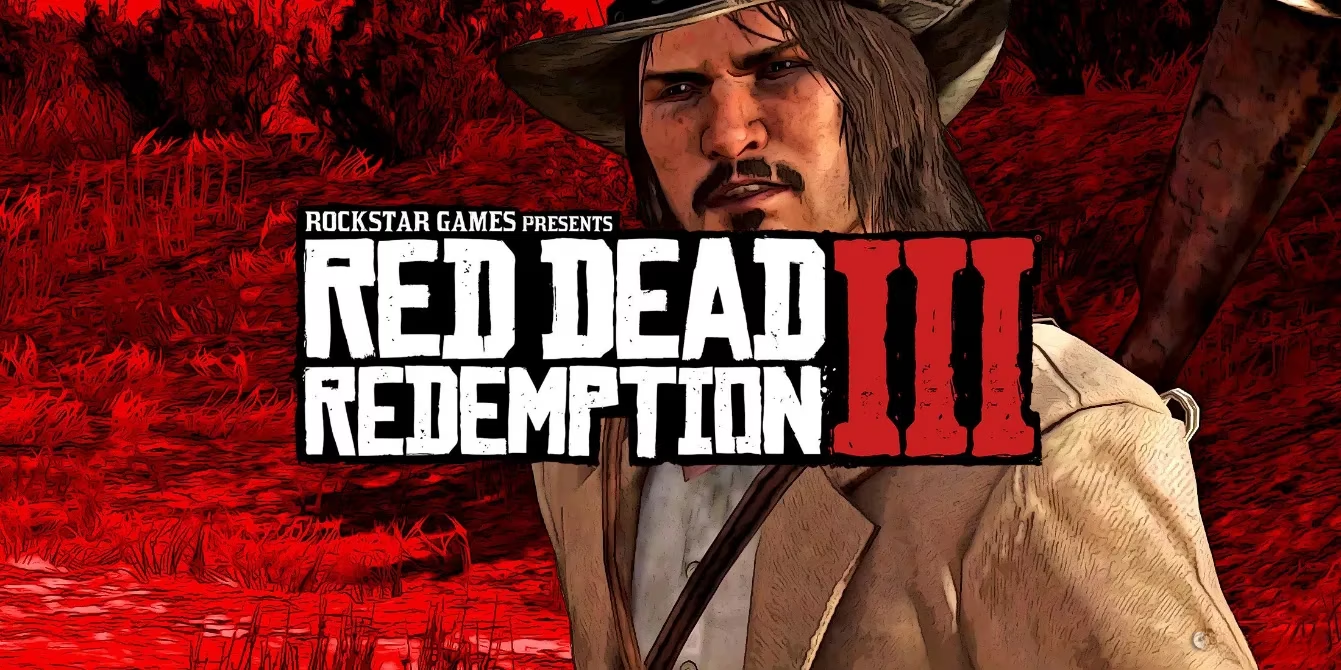
The quiet, studious boy from the gang's camp could grow into the chronicler of a vanishing era.
🎨 Carrying Arthur's Torch: A New Form of Creative Expression
Arthur Morgan's legacy isn't just that of a formidable outlaw; it's that of a complex, contradictory soul whose inner life of artistry starkly contrasted his violent exterior. This duality made him a legendary protagonist. Jack Marston offers a parallel path to explore a similar theme. Imagine:
-
Arthur's Tool: A pencil and journal for visual artistry—capturing landscapes, wildlife, and gang members with rough, honest lines.
-
Jack's Tool: A pen and journal for literary artistry—describing those same vistas, people, and moral conflicts with evocative prose, poetry, and reflection.
This shift wouldn't just be cosmetic. It would fundamentally alter the player's connection to the world. Where Arthur drew his observations, Jack would narrate them, offering a more subjective, interpretive, and philosophical lens on the events unfolding.
🌅 A Poet in a Changing World: The Perfect Historical Lens
Jack's adulthood unfolds in the early 20th century, a period far removed from the classic Wild West. The era of outlaws is gasping its last breaths, replaced by industrialization, the rise of the modern state, and World War I. Who better to document this tumultuous, rapid evolution than a sensitive writer who lived through the tail end of the old ways?
| Arthur Morgan's World (1899) | Jack Marston's Potential World (~1914+) |
|---|---|
| Untamed frontiers, nomadic gangs | Fenced land, dying towns, burgeoning cities |
| Moral ambiguity of survival | Moral ambiguity of progress and modernity |
| Artistic expression through drawing | Artistic expression through writing and poetry |
| Personal redemption for past sins | Searching for meaning in a world that outlawed his father's way of life |
Through Jack's journal, players could experience:
-
Poetic descriptions of a mechanized landscape encroaching on wilderness.
-
Reflective entries on legacy, justice, and the myth versus reality of the outlaw era he inherited.
-
Historical commentary woven seamlessly into personal narrative, making the player feel the weight of a turning epoch.
✍️ Gameplay Implications: The Journal Reimagined
A writer-protagonist opens up thrilling gameplay and narrative integrations:
-
Dynamic Journaling: Entries could become more than recaps. They could change tone based on Jack's morale, honor, or recent story events—shifting from hopeful to cynical, from descriptive to despairing.
-
Quest Integration: Side missions could involve Jack gathering stories, interviewing old-timers, or researching for a piece of writing, making exploration purpose-driven and narrative-rich.
-
Skill Progression: Jack's writing could improve over time, with early entries being simple and later ones becoming more nuanced and lyrical, mirroring his character growth.
🔮 The Bold Future: Beyond Cowboys and Revolvers
Choosing Jack Marston as the lead would be a daring narrative leap. It signals a readiness to explore the aftermath of the cowboy mythos, the quiet, psychological frontier that follows the gunfights. It's a story about memory, legacy, and finding one's voice in a world that has moved on. While theories about the next Red Dead abound—from entirely new characters to further prequels—a Jack-led game promises a poignant, direct link to the heart of the series. It would ensure that Arthur Morgan's spirit of introspection and artistry doesn't fade; it merely finds a new, equally powerful voice. In 2026, as gaming continues to push narrative boundaries, Red Dead Redemption 3 could offer not just a new chapter, but a whole new way of seeing, feeling, and remembering its world—one carefully written word at a time. 🖋️📓