The moment a player steps into The Legend of Zelda: Tears of the Kingdom, they are swept up by a world that seems both achingly familiar and startlingly new. As of 2026, three years after its release, the community’s magnifying glass has only grown sharper—uncovering threads that pull at the edges of the series’ sprawling timeline. Among these, one of the most tantalizing whispers points back to an ocean that once swallowed an entire kingdom. It seems that Tears of the Kingdom might hold a hidden handshake with The Wind Waker, a game separated by over two decades of real‑world time, but perhaps only a geological heartbeat in the mythology of Hyrule.
At first glance, the connection feels as fragile as a soap bubble drifting over a stormy sea. After all, Wind Waker’s sun‑drenched, cel‑shaded waves share little with the towering sky islands and cavernous Depths of the recent epic. Yet players who linger in the architectural bones of both worlds begin to notice something peculiar: a shared design language that whispers through stone and light. It is not the broad strokes of plot that bind them, but the fine grain of forgotten technology—a breadcrumb trail left by a civilization that refused to stay buried.
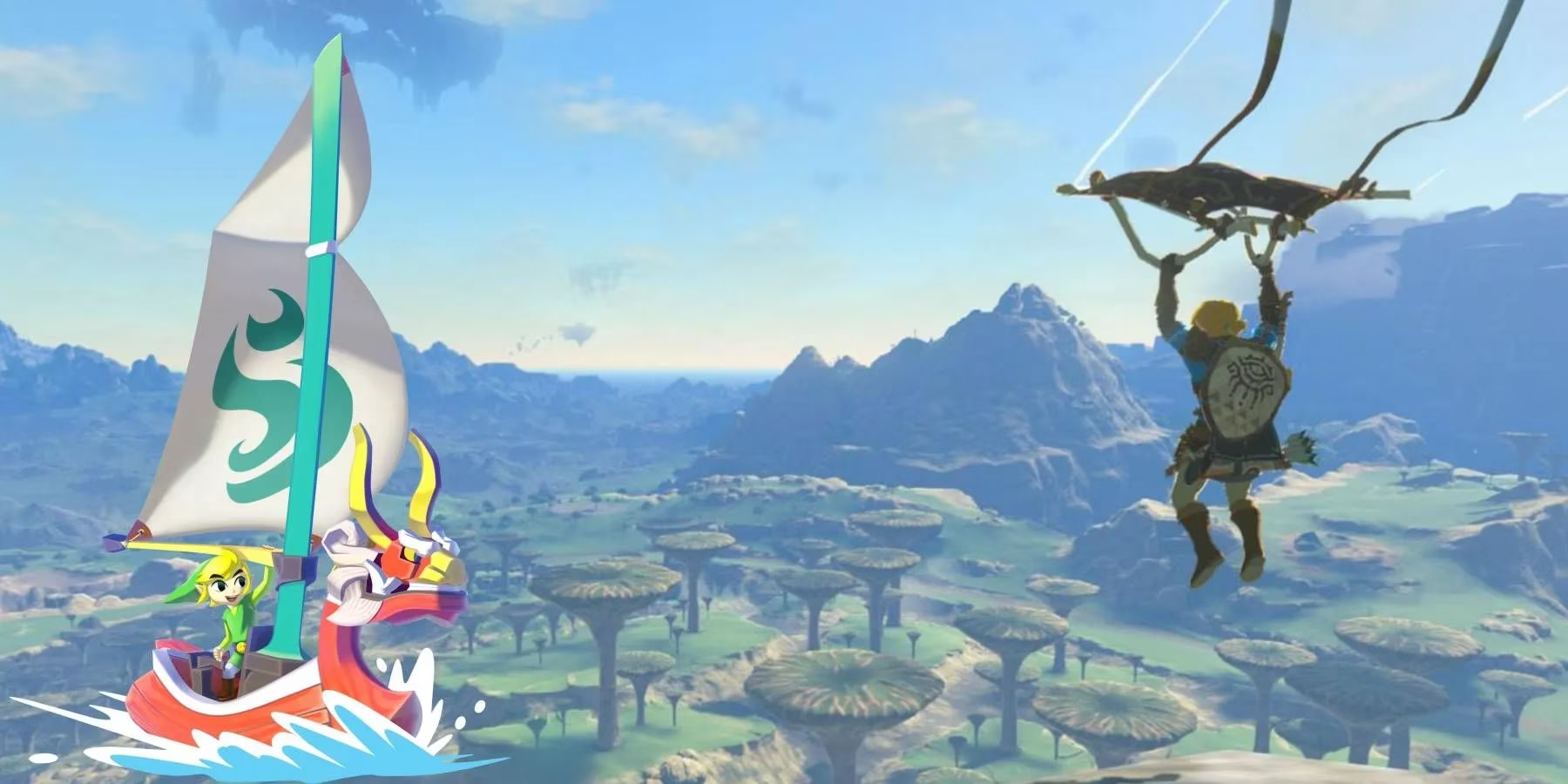
Take the simple act of soaring. In Wind Waker, the King of Red Lions carried Link across the Great Sea, a faithful vessel riding a world that had drowned. In Tears of the Kingdom, the Zonai glider becomes the player’s constant companion, stitching together sky and surface with a silent hum. The resemblance is more than just functional nostalgia; it is as if the same ancestral memory of travel has been passed down like a sea shanty, reshaped by every generation but retaining its core melody. The glider’s fabric might not catch the salt wind, but it catches something older—a yearning to bridge horizons that were meant to stay broken. This is the first flicker of a much larger reflection.
But the true heart of the mystery lies in two structures that could be sisters separated by an era. Wind Waker’s Tower of the Gods, rising from the ocean like a chrome‑plated myth, and Tears of the Kingdom’s Water Temple, suspended in the tumult of the sky, share an uncanny genetic code. The Tower of the Gods was a crucible—both a test and a revelation. Its walls pulsed with glowing blue circuits, patterns that looked less like magic and more like the dreams of a machine unable to sleep. Those same cerulean glyphs have now become the hallmarks of Zonai and Sheikah architecture in the modern era. It is as if two different civilizations, separated by a cataclysm, painted their ruins with ink drawn from the same celestial well.
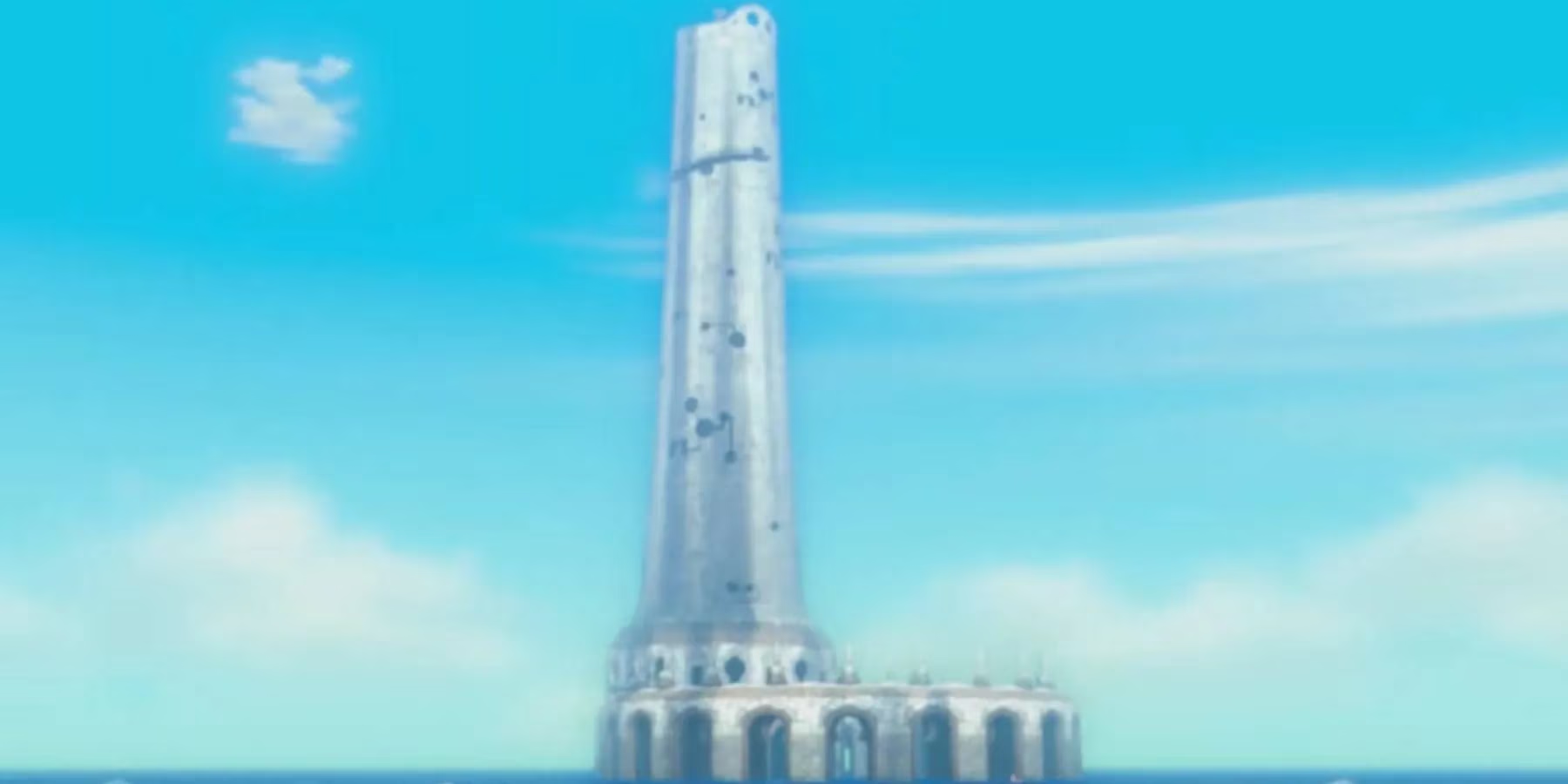
Step closer and the similarities become unnerving. Inside the Tower of the Gods, eye‑like turrets track Link’s movements before unleashing beams of searing light—a design motif that directly echoes the ancient Guardians that once roamed the fields of a post‑Calamity Hyrule. In Tears of the Kingdom, those same laser‑spitting sentinels have evolved, their gaze repurposed by Constructs and the ever‑patient Light Roots. It’s a touch that feels less like a coincidence and more like a fossil in a cliff face: a predator’s stare surviving across epochs because it simply works too well to be abandoned by evolution. One might say the technology has been “copy‑pasted by history,” like a genetic sequence that keeps expressing itself whenever the world rebuilds from scratch.
To the observant eye, the Tower of the Gods is an architectural palindrome, reading the same forward as it does backward across the timeline. Its circular hubs, concentric energy rings, and weight‑sensitive puzzles mirror the shrine layouts that have become the backbone of recent Zelda games. The Water Temple in Tears of the Kingdom isn’t just reminiscent—it feels like a descendant that has grown lighter, more ethereal, as if the original tower had shed its stone skin to float among the clouds. This metamorphosis calls to mind a second metaphor: a cicada leaving its shell on the same branch, season after season, the old husk intact while the singer has moved a few octaves higher. The shell is the Tower of the Gods; the song is carried now by structures like the Water Temple, still recognizably the same creature.
What makes this connection truly spark, however, is the buried secret of Wind Waker itself. Late in that game, the ocean is revealed to be a funeral shroud—the Great Sea covers a Hyrule that slid beneath the waves after a forgotten apocalypse. The kingdom wasn’t destroyed; it was simply put to sleep underwater, its people choosing to start again on mountaintops that became islands. Now, consider Tears of the Kingdom’s own lore: an ancient Hyrule, founded by the Zonai, flourished with impossible technology, only to be sealed away and eventually replaced by the kingdom we know. The water that drowned Wind Waker’s world could very well be the same force that swallowed the Zonai’s final, desperate works. If so, the Tower of the Gods is not merely similar architecture—it is a direct survivor, a lighthouse built by the same hands that sculpted the Sky Islands, still standing in the open air long after its siblings were inundated.
This timeline stitching feels like a paleontological dig where every brush stroke reveals a footprint from an animal no one thought could have walked that land. The emotional payoff is immense: it means when a player in 2026 dives into the cloudy depths of Tears of the Kingdom, they are swimming through the prelude of Wind Waker’s ocean. The Zonai devices, so buoyant and playful, become the embryos of the Tower’s robotic guardians. The watertight chambers of the Water Temple anticipate the flooded puzzle rooms that Link would one day conquer in a drowned labyrinth. History, in this reading, isn’t a straight line but a spiral, returning to the same coordinates at different altitudes—something the Zelda series has always hinted at with its recursive hero and princess, but now written in steel and stone.
The community has spent the past three years peeling apart these layers, and each new discovery only deepens the resonance. Modders and data miners have found that the glow patterns on Zonai shrines use a color palette nearly identical to the energy conduits of the Tower. Speedrunners, poring over every frame, noticed that the activation sequence of a Light Root when it bursts from the ground mirrors the ascension sequence of the Tower of the Gods from its underwater slumber. These are not just visual Easter eggs; they are systemic linkages, suggesting that the same underlying design philosophy was consciously reused across decades.
Of course, one could argue that the developers simply enjoyed revisiting a successful aesthetic. The Sheikah Slate’s runes, the Zonai’s swirling motifs, and the Tower’s luminous geometry could all be branches of a single art direction without narrative weight. Yet in a series that has built its identity on the weight of legend, every pattern wants to be a story. Even if the connection was not strictly intentional at first, the collective eye of millions of players has turned it into a truth with the gravity of canon. After all, myths are not made by their authors alone; they are polished by every person who stares into them and sees a fragment of a larger whole.
Looking forward, this thread could very well influence what comes next. If Tears of the Kingdom’s Hyrule is the ghost beneath Wind Waker’s water, future games might explore the in‑between—the slow drowning, the exodus, and the birth of the Great Sea. It would not be the first time the series has bridged its own islands of time, but it would perhaps be the most emotionally charged. Players in 2026 who stand on the edge of the sky, watching their glider unfurl, might just feel the phantom spray of an ocean that hasn’t fallen yet, a salt‑taste from a future that already remembers them. And that, more than any dungeon or boss, is the quiet magic only Zelda can conjure: the sense that every ending is just another tide going out, waiting to come back in.